Deadband Filter
Smooth noisy sensor data by ignoring small changes — only log a new reading when the value moves more than a set amount.
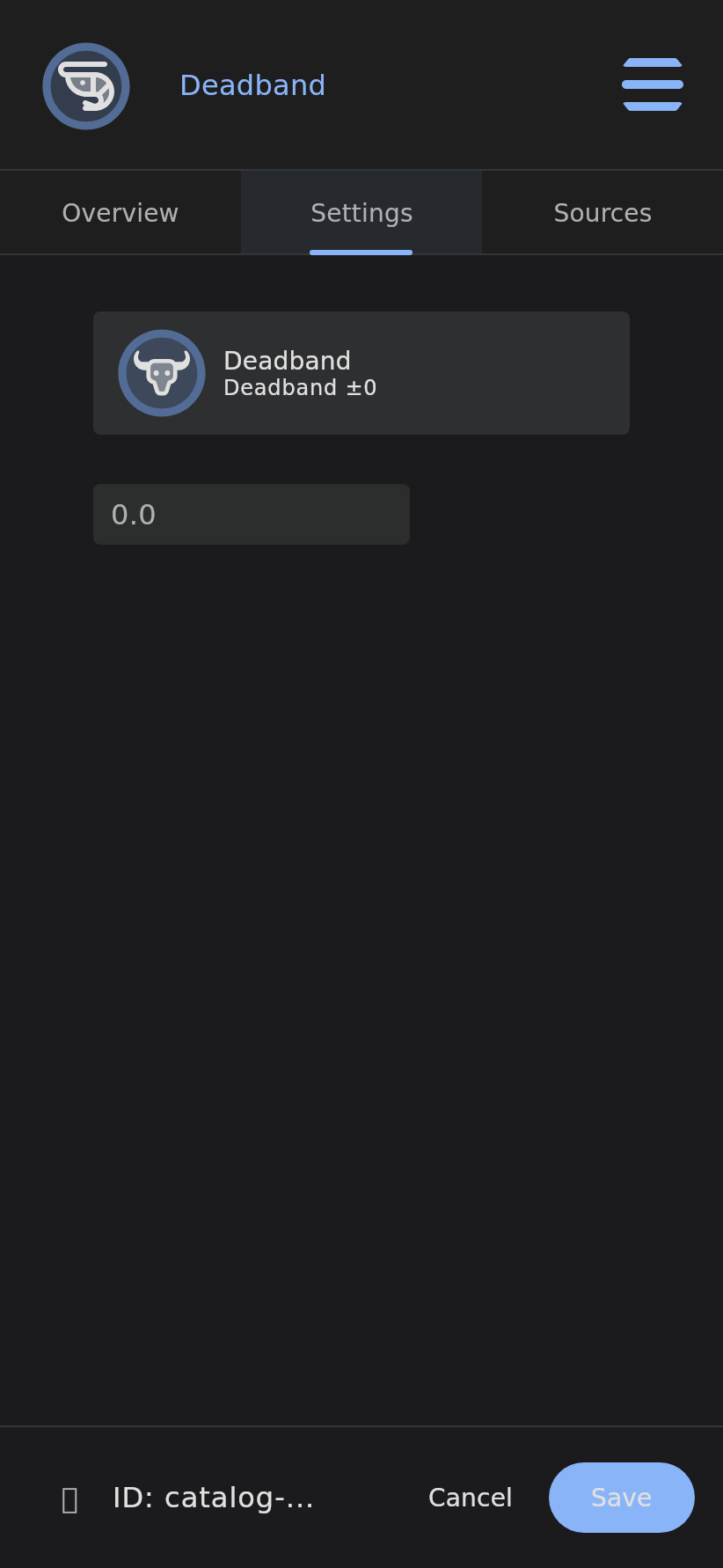
The Deadband filter rejects Data Point snapshots where the change from the previous value is smaller than a configured threshold. It computes |new_value − previous_value| and discards the snapshot if the change falls below the deadband value — suppressing noise from sensors by requiring a minimum change magnitude between consecutive readings.
Info: This is a Data Point Filter — a leaf node that sits under a Data Point’s filter chain and gates incoming snapshots before they are stored.
Overview
Analog sensors jitter. A temperature probe that reads 22.0 °C will happily report 22.01, 21.99, 22.02 between meaningful changes, filling your history with noise and triggering downstream automation for movements that don’t matter. The Deadband filter draws a band around the last accepted value and ignores anything that stays inside it.
How It Works
graph TD
    A[New snapshot arrives] --> B[Compute change = abs new − previous]
    B --> C{change >= deadband?}
    C -->|Yes| D[Accept snapshot, store, propagate]
    C -->|No| E[Discard snapshot]
    D --> F[previous = new value]
- A new snapshot arrives at the parent Data Point.
- The filter computes the absolute difference between the new value and the previously accepted value.
- If the change is greater than or equal to the deadband threshold, the snapshot is accepted, stored, and propagated to child triggers and executors.
- If the change is smaller, the snapshot is discarded and never stored.
Configuration
| Field | Description | Required |
|---|---|---|
deadband | Minimum change magnitude (Double) required to accept a new snapshot | Yes |
Use Cases
- Reduce noisy sensor data — only persist readings that represent real movement.
- Suppress jitter in analog readings such as temperature, pressure, or voltage.
- Only log meaningful value changes, keeping your time-series history compact.
Examples
- Only record temperature changes of at least 0.5 degrees.
- Ignore pressure changes smaller than 1 PSI.
- Suppress sensor noise — only log if the value changes by 2 or more.
Related
Last verified: 2026-05-21